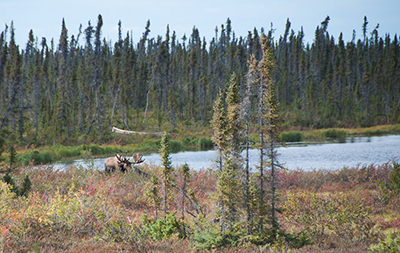
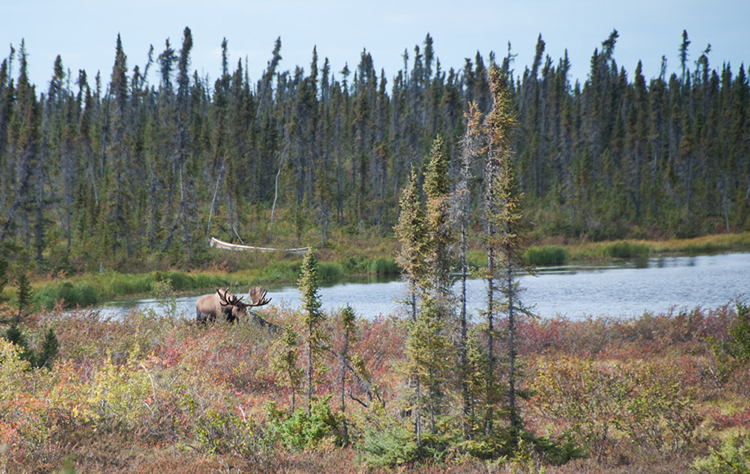
Moose in the Old Crow Flats. Photo by Trevor Lantz.
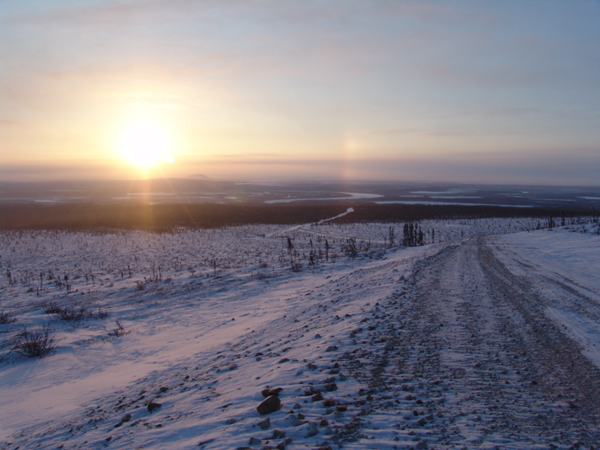
Mid-day sun over the community of Old Crow, YT. Photo by Kevin Turner.
Drained lake in the Old Crow Flats, YT. Photo by Trevor Lantz.
Research in the Arctic Landscape Ecology Lab focused on three main areas:
1. Understanding the impacts of catastrophic lake drainage on vegetation and soils. Field and remotely sensed data collected for this project shows that catastrophic lake drainage is followed by succession of plant communities that are a mix of dense willow thickets and sedge wetlands.
2. Assessing changes in the area and number of lakes in the Old Crow Flats using air photos and satellite imagery. This research shows that in recent decades, catastrophic lake drainage has become 5X more frequent. A change that has likely been caused by increased temperature and precipitation.
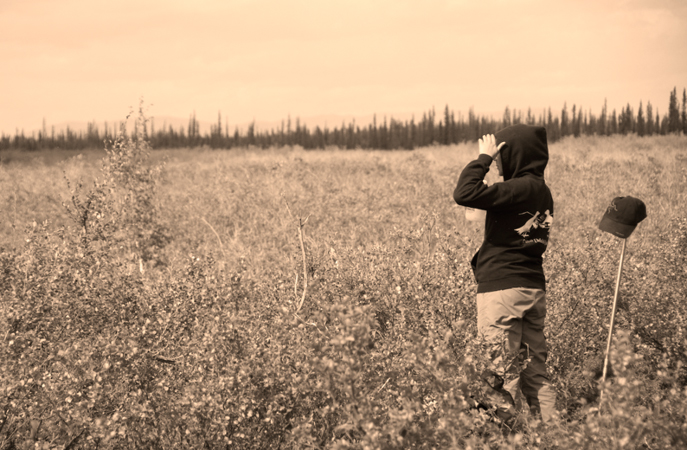
Erika Tizya-Tramm (UBC) at a drained lake in the Old Crow Flats, YT. Photo by Trevor Lantz.
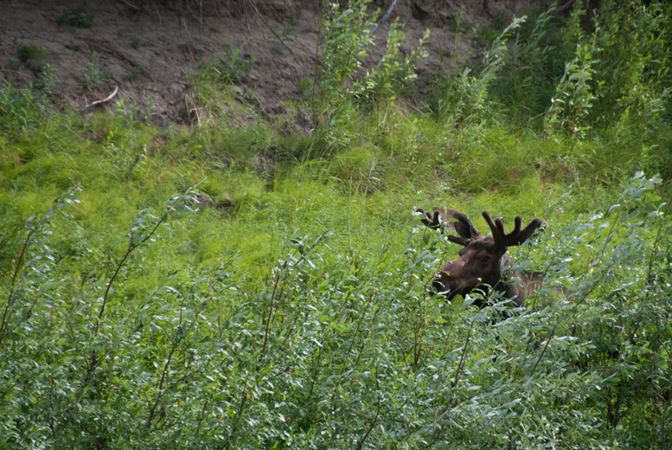
Moose in the willows along the Old Crow River, YT. Photo by Trevor Lantz.
3. Production of an object-based land-cover classification of the Old Crow Flats. This land-cover classification is being used to understand hydrological dynamics in the flats, as well as moose and muskrat habitat selection.
References
Clarke, H., Cooley, D., Humphries, M., Landry-Cuerrier, M., and Lantz, T. (2017). Summer habitat selection by moose on the Old Crow Flats. Report MR-17-01. Whitehorse, Yukon: Yukon Fish and Wildlife Branch. PDF
Lantz, T.C. (2017). Vegetation Succession and Environmental Conditions following Catastrophic Lake Drainage in Old Crow Flats, Yukon. Arctic. 70(2):177-189. doi:10.14430/arctic4646. PDF
Lantz, T.C. and Turner, K.W. (2015). Changes in lake area in response to thermokarst processes and climate in Old Crow Flats, Yukon. Journal of Geophysical Research: Biogeosciences. PDF
Turner, K.W., Wolfe, B.B., Edward, T.W.D., Lantz, T.C., Hall, R.I., Larocque G. (2014). Controls on water balance of shallow thermokarst lakes and their relations with catchment characteristics: a multi-year, landscape-scale assessment based on water isotope tracers and remote sensing in Old Crow Flats, Yukon (Canada). Global Change Biology. 20:1585-1603. doi:10.1111/gcb.12465. PDF